Have they told you the Utility Model is your best option?
Before you invest, you need to know the advantages and disadvantages of the Utility Model
Book Appointment
Get your Guide now
Examples of prototypes and inventions
Most utility model owners don’t fully understand the limitations of this form of protection. A utility model is inexpensive, fast, and easy to obtain—but it’s often not the best choice for businesses that rely on intellectual property as a core asset.
The utility model isn't really a patent. It's a weak protection tool, designed for inventions and products with limited innovation. More than 90% of inventors, startups, and companies that register a Utility Model choose this method without knowing its differences from other alternatives.
Most inventors who decide to register a utility model do so for one of these 3 reasons:
Have they told you the Utility Model is your best option?
Before you invest, you need to know the advantages and disadvantages of the Utility Model
Registering a utility model is really simple. The utility model does not require a substantive examination by specialists. Your description or documentation of the product will be published in an official gazette. If no one opposes it within 60 days, you'll get the title.
The documentation for a utility model can be drafted in just a few minutes. The rigor required to prove innovation is minimal. Most inventors choose the utility model to describe their idea and rely on its protection.
The official fees for registering a utility model don't even reach €90. If drafted by a consultant, the standard price for a utility model ranges between €1,500 and €3,500.
Almost 90% of the Utility Models applied for are approved. You'd have to be really unlucky for someone to see the gazette and actually decide to oppose it.
"In Spain, more than 88% of Utility Model applications are approved. In contrast, only 48% of patents are approved. Before investing in a utility model, you need to know the reason behind this phenomenon"
Erick Remedios Muiños
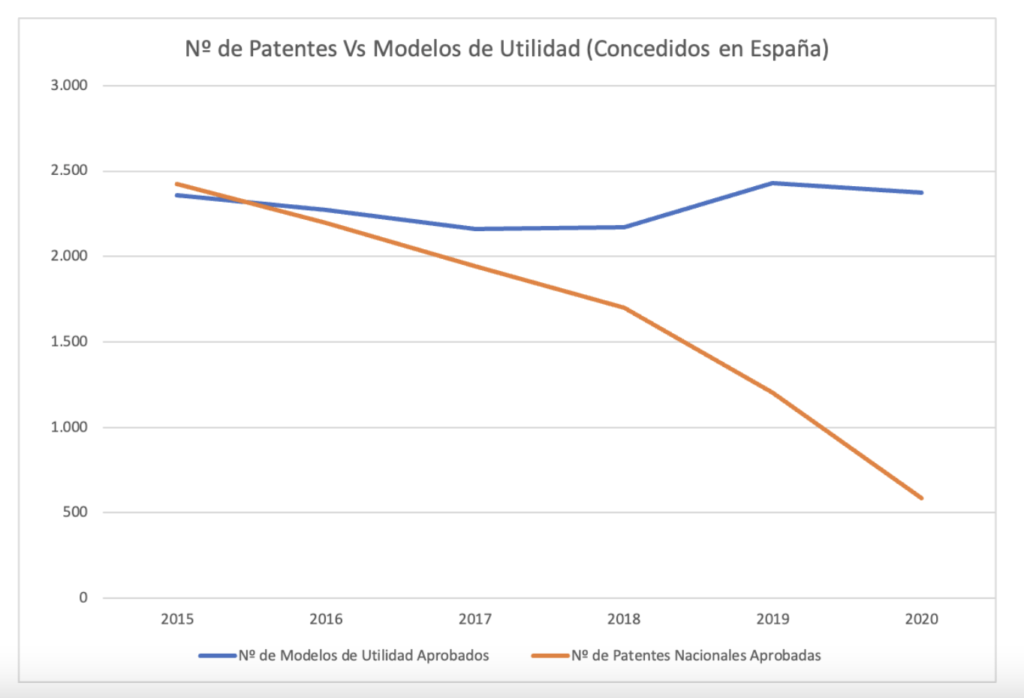
Data Source: Own elaboration, based on data extracted from the official website of the Spanish Patent Office
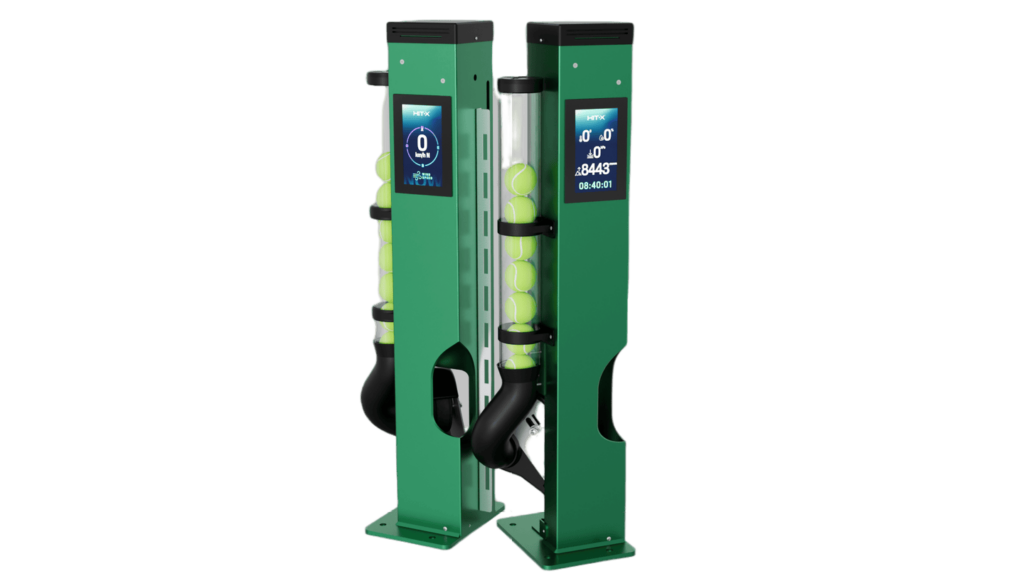
Padel court posts already existed, and so did ball-launching machines. Even so, we gave up on the utility model and secured a 20-year patent in the United States and other countries.
Utility models are not a patent, nor are they a precedent to make obtaining one easier. It's a parallel method that, far from helping, in most cases, hinders the creative process of a new product.
These are the 9 most visible differences between a utility model and a patent.
Criteria | Utility Model | |
Duration | 10 Years | 20 Years |
Innovation requirements | Weak | Strong |
Approval process | Does not require substantive examination | Requires substantive examination |
Taxes | 86€ | 1200€ |
Market Price | Between 1500€ and 3000€ | Between 7000€ and 15000€ |
Approval likelihood | 88% | 48% |
Ease of internationalization | 2% | 95% |
Sales posibility | 10% | 90% |
Although the disadvantages of the Utility Model are obvious, there are essential risk points that every inventor should be aware of.
Due to the lack of a rigorous examination, the utility model approval process consists of public disclosure.
The weakness of this protection method and the product's technological immaturity at this stage turn the utility model into a source of inspiration for third parties to copy the ideas.
Most utility models describe ideas with a low level of technical maturity.
Intellectual property consultants with little or no experience in product development rush to imagine what would be best for its operation.
This leads to utility models that, far from protecting inventions, condemn the creative process.
In the most serious and dynamic markets for buying and selling patents, the utility model does not exist.
If your business idea is to license or sell the intellectual property to a large company, the utility model is your worst option.
Due to the similarity of the names, it is common to confuse the utility model with the utility patent.
The Utility Patent (P. Utilidad) is an American patent, equivalent to an invention patent in Spain. The Utility Model, on the other hand, does NOT exist in the United States.
If you've been told that nothing similar to your invention exists, it's likely that your invention is not viable — or that not enough research has been done. In 99% of cases, there is prior art that must be studied before creating a protection strategy.
80% of utility models could actually be patented. Inventors choose to register a utility model either because they are not well advised or because they lack sufficient resources.
Therefore, most advisors recommend the utility model as the first option because they know they would lose a large part of their sales otherwise.
Registering a utility model too early carries more risks than benefits. If you register a utility model before building a prototype, you will be sharing your idea without having optimized the solution.
As you may have concluded by now, for intellectual property advisors or patent attorneys, it will always be easier and more financially attractive to file a Utility Model rather than a Patent or Industrial Design. Therefore, if the improvements you propose to an invention are related to its shape or aesthetics, it may be more advisable to protect an invention through an Industrial Design.
Many inventors consider registering their idea as a strategy to sell it. The truth is that the chances of finding a buyer for a Utility Model are extremely low.
Since it is an invention protection method not accepted in countries like the United States, the chances of interest from companies or patent buyers are reduced by more than 80%.
Approval likelihood | 2020 | 2021 | 2022 | Average |
97,39% | 99,70% | 93,63% | 96,91% | |
UTILITY MODEL | 69,41% | 107,49% | 87,06% | 87,98% |
39,65% | 49,30% | 54,10% | 47,68% |
As you can see, taking as a reference the approval rates for Invention Patents (47%), Industrial Design (97%), and Utility Model (88%), you’ll find a clear answer as to why most intellectual property advisors almost always recommend the Utility Model as a method to protect an invention.
The Utility Model is the invention protection method with the highest profit margin for intellectual property advisors. Likewise, it is much more likely that the Patent and Trademark Office will approve a Utility Model than an Invention Patent.
The likelihood that the Patent and Trademark Office will grant Utility Model titles is very high. This probability is linked to the low level of scrutiny applied when evaluating a Utility Model, as a substantive examination is not required.
To apply for a Utility Model, it is necessary to write a descriptive report of the invention. If the invention report meets the formal requirements set by the Patent Office, the invention will be published in the Official Bulletin of Patents and Trademarks. If no inventor or company files an opposition within 60 days of publication, the Utility Model will be approved. However, this does not mean that the Utility Model can later be converted into an Invention Patent.
When you have an idea that improves an existing product, but the innovation is not too relevant, it is likely that the Utility Model is the best way of protecting the invention. If you are selling your product and it closely resembles a product that is patented or registered as an Industrial Design, it is likely that the judge will refrain from issuing precautionary measures until a final decision is made. Specifically, the main advantage of having a Utility Model is being able to take advantage of time, selling products, until a decision is made in a patent dispute. If your intention is to protect the invention from being copied, internationalize the sale of a novel or improved product, or you intend to sell an invention to a large company or sell a patent to an investor, registering a Utility Model is highly unadvisable.
Due to the internationalization process and recognition of the method worldwide, for the protection period it offers, and for the rigor of the examinations required for approval. It is more advisable to protect an invention with a patent than with a Utility Model.
The rigor of the examinations to approve a Utility Model and an Industrial Design are very similar. In both cases, the patent office is limited to ensuring compliance with document forms, but does not assess the innovation capacity of the registrations. However, Industrial Design has greater international recognition than Utility Models. Additionally, considering the official fees of the patent office along with the fees typically charged by intellectual property advisors, registering an industrial design is usually almost 2 times cheaper.
According to our experience, the utility model is useful in cases where the product you are marketing is very similar to other patented products.
If you receive a claim, you could gain additional time to keep marketing the product until the legal issue is resolved.
In this case, if you don’t have at least a utility model, they could order your product to be withdrawn from the market before the legal issue is resolved.
The price of a utility model is the sum of: official fees and advisor fees.
In Spain, a utility model usually costs between €1,500 and €3,000.
That's right. Applying for a utility model for an invention is actually quite cheap.
The difference between the official fee and the total cost of a utility model lies in the fees charged by the patent attorney or advisor.
The Utility Model is a fairly straightforward process. From submission to approval of a Utility Model, it takes approximately 3 months, including the period for exposure of the Utility Model in the Official Gazette of Patents and Trademarks. The process of exposing a Utility Model takes about 60 days. This is the period during which other inventors may oppose the approval of a Utility Model if it bears resemblance to their previously protected inventions.
According to our experience, many inventors who register a Utility Model, subsequently do not maintain a surveillance service of their protected inventions, as substantive examination is not necessary to protect the Utility Model, often, very similar or even nearly identical registrations can be detected at the patent and trademark office.
The price of registering a Utility Model is not particularly cheap. The cost of the Utility Model consists of the sum of the official fees imposed by the patent and trademark office plus the fees of the intellectual property advisors. The fees are approximately 120€, so the cost of filing a Utility Model typically ranges from 120€ to 2000€ or 3000€, which is the economic margin of the advisors who handle this type of advice. While the prices of a Utility Model are lower than patent prices, for intellectual property advisors, they are a much more profitable method, as they require less effort to prepare while the possibilities of applications are substantially higher, as you can see in the comparisons presented above.
The Utility Model is a method of protecting inventions with low rigor in terms of innovation and low rigor in its examination procedure by the patent and trademark office. This low rigor is well known to large companies and patent buyers, so in most cases, according to our experience, it is cheaper and more viable for a company to improve the content or the invention of a Utility Model than to buy it. Based on our experience, patent buy-sell operations are conducted on patents with clear opportunities to be internationally protected. If the inventor's strategy is to protect an invention and then sell the patent, it is advisable to invest time and effort in protecting a utility patent instead of a Utility Model
The protection period of a Utility Model is also shorter than the protection period of a patent. This is another clear argument for choosing a patent when the strategy is to negotiate with patent buyers to monetize an invention.
The time to bring your ideas to life is now. We accompany you throughout the entire process: from idea to product.
San Juan Ingenieros, S. L, is the owner of the domain www.letsprototype.com, and in accordance with the General Data Protection Regulation (EU 1679/2016), we will process your data exclusively to handle your information request. You have the right to rectify or request the deletion of your data at any time via hello@letsprototype.com.